
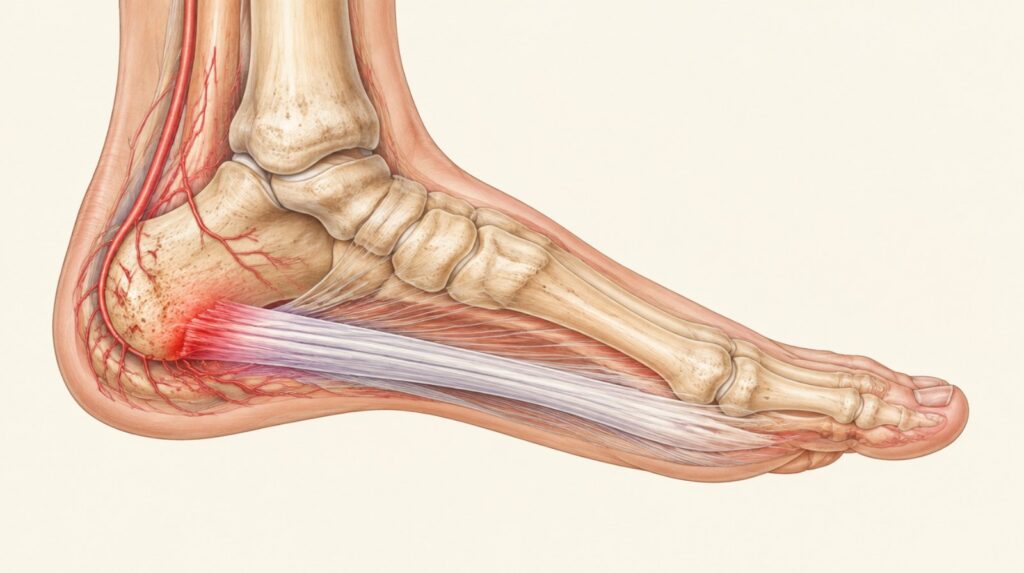
In brief
This guide is for patients with chronic plantar fasciitis (heel spur) who are considering embolization or preparing for it. It explains how to prepare for the procedure, what happens on the day of treatment, what recovery looks like, what to expect and which questions are worth asking at your consultation.
Who is this guide for?
This guide is for patients with chronic plantar fasciitis (heel spur) who are considering embolization or who already have a procedure date. It explains in plain language how to prepare, what happens on the day of the procedure, what recovery looks like and what is worth asking at your consultation. The information is general and does not replace the personal instructions you receive from the medical team. If anything here differs from what you have been told, follow the instructions you were given.
What is plantar fasciitis embolization, in brief?
Embolization is a minimally invasive procedure performed through a catheter, with no incision in the foot. An interventional radiologist navigates a thin catheter to small inflamed blood vessels around the heel and blocks them selectively, with the aim of helping to reduce pain. Important to know in advance: for plantar fasciitis, this is a relatively new treatment. The data published so far come mainly from small series of patients, and long-term follow-up is still limited. For this reason the treatment is considered only in selected patients, after prolonged conservative treatment has not brought enough improvement.
Before the procedure: the consultation
Preparation starts with a consultation. At the visit the doctor reviews the course of your pain, checks which treatments have already been tried and goes over your imaging. It is helpful to bring:
- Medical summaries and letters from your treating doctors.
- Imaging of the foot, if you have had any: X-ray, ultrasound or MRI.
- A list of the treatments you have tried and how you responded to each one.
- An up-to-date list of medications, including blood thinners and supplements.
- Information about allergies, especially sensitivity to contrast material or iodine.
- Information about underlying conditions, such as diabetes, kidney disease or vascular disease.
At the end of the visit you may be referred for blood tests or additional imaging. The conclusion may also be that the procedure is not suitable for you, and that is a legitimate outcome of a good consultation.
How do you prepare in the days before the procedure?
- Follow the instructions you were given about your regular medications. Do not stop blood thinners or other medications on your own.
- Check in advance whether you need to fast, and for how many hours before the procedure.
- Arrange for someone to accompany you and take you home.
- Let the team know if you develop a fever, an infection, a wound on the foot or any change in your health.
- Prepare comfortable, roomy shoes for the day of the procedure.
What happens on the day of the procedure?
The procedure takes place in an angiography suite, under imaging guidance. It is usually done with local anesthesia at the point where the catheter enters the blood vessel, and sometimes with light sedation at the doctor’s discretion. The main steps:
- Admission, a short conversation with the team and signing informed consent.
- Local anesthesia and insertion of a thin catheter into a blood vessel.
- Navigating the catheter to the vessels around the heel and identifying the inflammatory vessels.
- Injecting a controlled amount of embolic material.
- Removing the catheter and applying pressure or a dressing to the puncture site.
You may feel pressure or mild discomfort during the procedure. If something bothers or worries you, you can and should tell the team right away.
What happens right after the procedure?
After the procedure you stay for observation, as decided by the medical team, and you usually go home the same day. Before you leave you will receive written instructions about the puncture site, activity, medications and your follow-up appointment.
Recovery in the first days and weeks
- There may be tenderness or a small bruise at the puncture site, usually temporary.
- There may be tenderness or a temporary change in skin color on the foot.
- The return to activity is gradual, according to the instructions you were given.
- It is usually important to continue stretching, suitable footwear and tailored exercise after the procedure as well.
- Come to your follow-up appointment as scheduled, even if you feel well.
What can you expect in terms of pain?
Improvement, when it comes, may be gradual and is not always immediate. The response to treatment varies between patients: some report relief, and in others the improvement is partial or not sufficient. The result is not guaranteed, and because published long-term follow-up is still limited, it is not possible to say with certainty how long any relief will last. Additional treatment may be needed.
When should you contact a doctor after the procedure?
Contact the treating team or seek urgent medical care if you notice:
- Bleeding or growing swelling at the puncture site.
- Severe or worsening pain in the foot.
- A cold, pale or bluish foot, or new numbness.
- A wound or skin change that does not improve.
- Fever, redness or discharge.
- Shortness of breath, a rash or other signs of an allergic reaction.
Questions worth asking at your consultation
- Does my diagnosis fit this treatment?
- Which conservative treatments should I try first?
- What is known from research about this treatment, and what is not yet known?
- What are the possible risks given my medical condition?
- What are the alternatives, including continuing conservative treatment?
- How should I manage my regular medications before the procedure?
- When will I be able to return to work, long walks and sport?
- What happens if the pain does not improve?
Want to find out whether this treatment may be suitable for you?
Contact us to schedule a consultation with Dr. Adam Farkas, a specialist in interventional radiology, and find out whether plantar fasciitis embolization may be suitable for you.
Further reading
Frequently asked questions
How do I prepare for plantar fasciitis embolization?
Preparation includes a consultation, a review of your imaging and regular medications, and sometimes blood tests. Instructions about fasting and medications are given individually before the procedure.
Is the procedure done under general anesthesia?
Usually not. The procedure is generally performed with local anesthesia at the point where the catheter enters the blood vessel, and sometimes with light sedation at the doctor's discretion.
Do I go home the same day?
Usually, yes. After the procedure you stay for observation as decided by the medical team, and most patients go home the same day with someone accompanying them.
When will I feel an improvement in pain?
Improvement may be gradual and is not always immediate, and the response varies between patients. The result is not guaranteed.
What is known from research about this treatment?
It is a relatively new treatment. The data published so far come mainly from small series of patients, and long-term follow-up is still limited.
Do I need to keep up stretching and insoles after the procedure?
Usually, yes. Stretching, suitable footwear and tailored exercise remain an important part of treatment after embolization as well, according to the doctor's instructions.
