
In brief
Benign prostatic hyperplasia can cause significant urinary problems and impair quality of life.
Prostatic artery embolization (PAE) is an advanced, minimally invasive treatment that provides symptom relief without surgery or compromising sexual function.
Getting up three or four times a night to urinate?
It usually starts small. Once a night, then twice, and at some point you are planning your day around where the nearest bathroom is. The stream is weak, it takes a while to get going, and there is always the feeling that your bladder has not fully emptied. Many men live like this for years because they assume the only real fix is surgery, and they are not ready for that.
In most men over 50, the cause is benign enlargement of the prostate, known as benign prostatic hyperplasia (BPH). The prostate surrounds the urethra, the tube that carries urine out of the body, and as it grows it squeezes it. The good news is that an enlarged prostate can now be treated without an incision and without general anesthesia, through a catheter-based procedure called prostate artery embolization (PAE).
This page brings together what you need to know before deciding: who PAE suits and who it does not, how the process works from the first consultation to the procedure, what happens on the day, what recovery looks like, the risks, and what the research shows when PAE is compared with surgery.
What is PAE, in brief
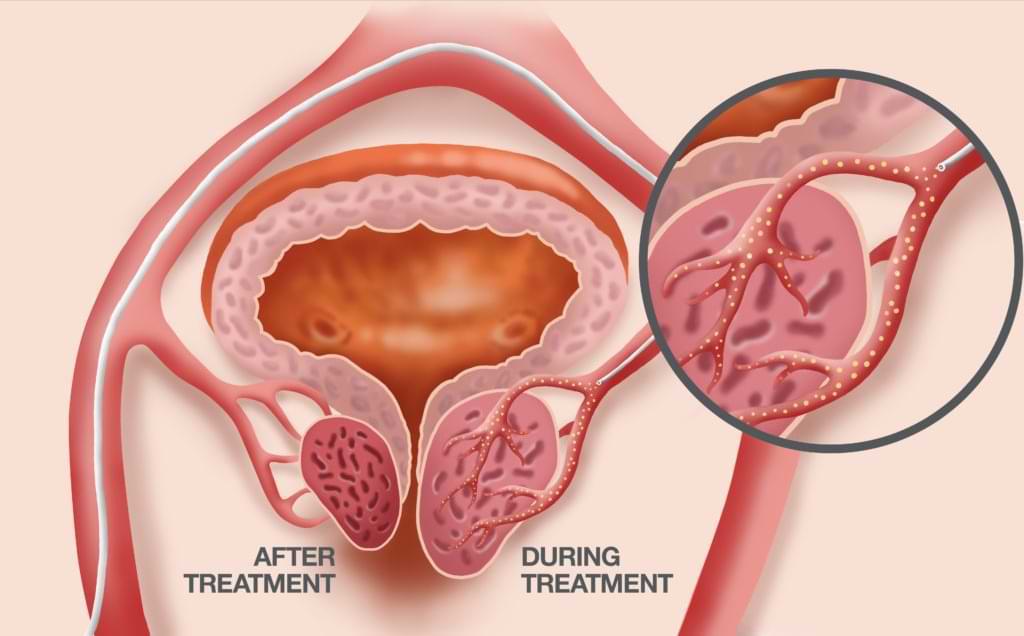
Prostate Artery Embolization (PAE) is a minimally invasive procedure used to treat benign prostatic hyperplasia (BPH). It works by reducing blood flow to the prostate, causing it to shrink gradually and relieve urinary symptoms without surgery. As the prostate gets smaller, pressure on the urethra drops and urination becomes easier.
A catheter procedure means a very thin tube, about as thin as a strand of spaghetti, is passed through a blood vessel, and the treatment is delivered from the inside. PAE is performed by an interventional radiologist under imaging guidance, so the doctor sees exactly where the catheter is at every moment.
Symptoms that bring men in for an assessment
- Waking several times a night to urinate
- Needing the bathroom frequently during the day
- Difficulty starting the urine stream
- A weak or interrupted stream
- Feeling that the bladder has not emptied completely
- Sudden urgency that is hard to hold
These are typical symptoms of an enlarged prostate, but they can have other causes too. Only a medical assessment can determine what is behind them in your case. For more on the condition itself, diagnosis and the range of options, see Enlarged prostate (BPH) and prostate artery embolization.
Who is a good candidate for PAE, and who is not
PAE is usually considered for
- Men experiencing moderate to severe urinary symptoms from an enlarged prostate
- Patients who did not respond well to medication, or who cannot tolerate its side effects
- Patients who wish to avoid surgery, for example because of concern about sexual function
- Patients with high surgical risk due to age or other medical conditions
- Men with a very large prostate, where surgery through the urethra is more complex
PAE has also been studied in men who depend on a urinary catheter because they cannot empty their bladder. In a large series of 1,075 patients published in the Journal of Vascular and Interventional Radiology, 119 of the 126 men who arrived with a catheter (94%) were catheter-free three months after the procedure [4].
When PAE may be less suitable
Not every enlarged prostate is suitable for embolization. Eligibility is decided only after a full medical evaluation and imaging, and sometimes the recommendation will be a different treatment. Situations that need particularly careful assessment include:
- Suspected prostate cancer that has not yet been ruled out
- Severe atherosclerosis or very tortuous arteries that make it hard to reach the prostate arteries
- Significant kidney impairment or a contrast allergy
- Bladder problems in which the prostate is not the main cause of symptoms
An important part of the workup is confirming that the prostate really is the source of the problem, and that the anatomy of the blood vessels allows the procedure to be done safely. If PAE is not the right option for you, Dr. Farkas will explain why and which alternatives are worth exploring with your urologist.
The process: from referral to treatment day
Step 1: Consultation in Modiin
Private consultations take place at the Elite Medical clinic in Modiin on Mondays. Dr. Farkas reviews your symptoms, imaging and test results with you, explains which options exist and checks whether a catheter-based treatment suits your condition. Please bring a referral letter, imaging discs, blood tests and medical records, including PSA results and ultrasound reports if you have them. An initial video consultation can also be arranged.
Step 2: Further tests
Before PAE you will usually need imaging of the prostate and of the pelvic blood vessels, so the route to the prostate arteries can be planned in advance. Blood tests, a urology assessment and a symptom questionnaire may also be needed. If you take blood thinners, you will be told whether and when to pause them.
Step 3: Scheduling
The procedure itself is performed in the angiography suite at Shaare Zedek Medical Center in Jerusalem. Our office explains the coverage options and books the date. Before the procedure you receive exact instructions: when to fast, which morning medications to take, and what to bring.
What happens on the day
Arrival and preparation
You arrive in the morning, are admitted and have an IV line placed. Most patients come with someone who can drive them home at the end of the day.
Anesthesia
PAE is performed under local anesthesia, with sedation as needed. General anesthesia is not required. You stay awake or lightly drowsy, breathe on your own and can talk to the team.
The procedure, step by step
- A tiny entry point: a small puncture in the skin, usually in the groin or the wrist, through which a thin catheter enters a blood vessel.
- Image-guided navigation: under precise imaging, the catheter is guided to the prostate arteries on both sides.
- Controlled embolization: tiny particles are injected through the catheter to reduce blood supply to parts of the prostate.
- Finishing: the catheter is removed and the entry point is closed with pressure or a small closure device.
The procedure usually takes about an hour, followed by an hour or more of recovery. PAE is a day procedure, and in most cases you go home the same day, with no overnight stay. In most cases the only visible sign afterwards is a small 2 to 3 millimeter puncture mark.
Does it hurt?
This is the most common worry before any catheter procedure. Discomfort is minimal, and it is reduced with local anesthesia and sedation. Most patients mainly feel the sting of the local anesthetic injection, and sometimes a brief warm sensation when contrast is injected.
Recovery: the days and weeks after PAE
The first few days
Most patients return to normal activities within a few days. Frequent urination, burning, pelvic discomfort or tiredness may occur. Urinary symptoms sometimes get a little worse for a short time before they start to improve. You will be given medication for comfort and clear instructions on what to do if something does not feel right.
One to two weeks
The temporary symptoms after the procedure typically resolve within this period. Office work can often be resumed earlier, depending on how you feel.
The following weeks and months
The prostate continues to shrink gradually, and symptom relief builds up over weeks to months. It is worth knowing this in advance: improvement is a process, and it does not all arrive the day after. Follow-up is set out in your discharge letter and usually includes a symptom questionnaire and sometimes repeat imaging.
Risks and side effects
Every medical procedure carries risks, and it is important to understand them before deciding.
- Common, temporary effects: mild pelvic pain, frequent urination and a burning sensation. They usually settle within one to two weeks.
- Blood in the urine or semen: may appear in the days after the procedure and usually clears on its own.
- At the puncture site: a small bruise or local tenderness.
- Significant complications: rare, and include bleeding, blood clots, infection, and injury to blood vessels or nearby organs if particles reach an unintended area.
- Radiation: PAE is guided by X-ray imaging. Modern equipment and dedicated techniques reduce the radiation dose.
To put this in numbers: in a series of 1,075 patients, 7 (0.65%) had a severe adverse event under the Society of Interventional Radiology classification, and all resolved without permanent effects [4]. In a randomized trial against TURP surgery, fewer adverse events occurred after PAE than after surgery (36 versus 70 events) [1].
Because the procedure requires a high level of expertise, it should be performed by an experienced interventional radiologist. Dr. Adam Farkas directs the Vascular Interventional Radiology Unit at Shaare Zedek Medical Center and chairs the Israel Society of Interventional Radiology. More about Dr. Farkas.
PAE compared with surgery (TURP)
The most common operation for an enlarged prostate is transurethral resection of the prostate (TURP). It is a long-established and effective operation, and in some situations it is the right choice. The main differences:
| Topic | Prostate artery embolization (PAE) | Prostate surgery (TURP) |
|---|---|---|
| Approach | Thin catheter through a blood vessel, no surgical incisions | Surgical instrument through the urethra |
| Anesthesia | Local with sedation | Usually general or spinal |
| Hospital stay | Usually a day procedure | Usually at least one night |
| Back to routine | Within a few days, in most cases | Longer recovery |
| Sexual function | Very low risk of harm | Higher risk, especially retrograde ejaculation |
| Strength of effect | Meaningful symptom relief, somewhat less than surgery on flow measures | Stronger improvement in flow and prostate size |
What the research says about the comparison
In a randomized trial from Switzerland published in the BMJ, 103 men were randomly assigned to PAE or TURP. PAE was performed under local anesthesia and TURP under spinal or general anesthesia. At 12 weeks, the symptom score (IPSS) fell by an average of 9.2 points after PAE and 10.8 points after TURP. Surgery produced greater improvement in urine flow, residual urine and prostate size, while PAE was followed by fewer adverse events [1].
A 2024 systematic review and meta-analysis including 810 patients reached a similar conclusion: surgery improves urodynamic measures more, while PAE is associated with fewer adverse events. The authors described PAE as an option for patients who cannot undergo surgery or in whom medical therapy has failed [5].
Put simply, surgery is stronger on the mechanical measures, and PAE is gentler, with a shorter recovery and lower risk. The right choice depends on the size of your prostate, how severe your symptoms are, your general health and what matters most to you. The decision is made together with your treating doctor, and often with your urologist.
How effective is PAE, and for how long
In Dr. Farkas’s clinical experience, the success rate of the procedure is between 70 and 90 percent, depending on each patient’s condition. Published research also supports its effectiveness:
- Against a sham procedure: in a randomized trial published in European Urology, 80 men with severe symptoms received either real PAE or a sham procedure. At six months, improvement in the symptom score was 13.2 points greater in the PAE group than in the sham group [2].
- Over the long term: in a study of 1,072 patients followed for up to ten years, the average improvement in symptom score at the last visit was about 10 points, after a mean follow-up of more than four years [3].
It is also important to know the other side: the prostate can keep growing over the years. In the same long-term study, 21.1% of patients needed further treatment within 5 years and 58.1% within 10 years, whether repeat PAE, surgery or medication [3]. Some men also need further treatment after surgery, and this is a good question to raise at your consultation. For more on what to ask before choosing, see PAE: what you need to know before choosing a non-surgical treatment.
Is PAE right for you?
Suitability is decided at a consultation, after reviewing your imaging and test results. Please bring all your medical records. If your knees are also a problem, read about genicular artery embolization (GAE) for knee pain.
This page provides general information and does not replace personal medical advice. Results vary from patient to patient.
One more question
Where is the consultation and where is the procedure?
Private consultations are held at the Elite Medical clinic in Modiin on Monday afternoons. The procedure itself takes place in the angiography suite at Shaare Zedek Medical Center in Jerusalem. To book, see our contact page.
Sources
- Abt D, et al. Comparison of prostatic artery embolisation (PAE) versus transurethral resection of the prostate (TURP) for benign prostatic hyperplasia: randomised, open label, non-inferiority trial. BMJ. 2018;361:k2338. doi.org/10.1136/bmj.k2338
- Pisco JM, et al. Randomised Clinical Trial of Prostatic Artery Embolisation Versus a Sham Procedure for Benign Prostatic Hyperplasia. European Urology. 2020. doi.org/10.1016/j.eururo.2019.11.010
- Bilhim T, et al. Long-Term Outcome of Prostatic Artery Embolization for Patients with Benign Prostatic Hyperplasia: Single-Centre Retrospective Study in 1072 Patients Over a 10-Year Period. Cardiovascular and Interventional Radiology (CIRSE). 2022. doi.org/10.1007/s00270-022-03199-8
- Bhatia S, et al. Prostatic Artery Embolization: Mid- to Long-Term Outcomes in 1,075 Patients. Journal of Vascular and Interventional Radiology (SIR). 2025. doi.org/10.1016/j.jvir.2024.11.002
- Altman R, et al. Comparing prostatic artery embolization to surgical and minimally invasive procedures for the treatment of benign prostatic hyperplasia: a systematic review and meta-analysis. BMC Urology. 2024. doi.org/10.1186/s12894-023-01397-1
Frequently asked questions
Is PAE done under general anesthesia?
No. PAE is performed under local anesthesia, with sedation as needed. General anesthesia is not required, which is one reason it can suit older patients and those with other medical conditions.
Do I need to stay overnight in hospital?
No. PAE is a day procedure. In the vast majority of cases you go home the same day after a few hours of observation.
Does it hurt?
Discomfort is minimal, and it is reduced with local anesthesia and sedation. You may feel brief, mild discomfort, mainly when the local anesthetic is injected, and some burning or pelvic discomfort in the days afterwards.
Is PAE an alternative to surgery?
Yes. For suitable patients, PAE is an alternative to surgery, with fewer complications and a much shorter recovery. In a randomized trial against TURP, fewer adverse events occurred after PAE, although surgery achieved greater improvement on flow measures [1].
What is the success rate?
In Dr. Farkas's clinical experience, between 70 and 90 percent, depending on each patient's condition. At your consultation you can ask what to expect in your specific case.
What exactly is a catheter procedure?
A minimally invasive procedure in which a catheter, a tube about as thin as a strand of spaghetti, is passed through a blood vessel and the treatment is delivered through it, without opening the body.
Does PAE affect sexual function?
PAE has a very low risk of causing erectile dysfunction or retrograde ejaculation, which is one reason men who want to preserve sexual function consider it.
How soon will I notice improvement?
Improvement is gradual. Some men notice a difference within a few weeks, while for others relief builds over several months as the prostate shrinks.
How do I prepare for PAE?
Preparation usually includes imaging studies, blood tests and pausing certain medications as instructed by your doctor. You will receive exact instructions before the procedure.
Will there be a scar?
Almost all catheter procedures are done through a tiny 2 to 3 millimeter entry point in the skin. In most cases no scar is visible.
