
The most common lasting side effect of TURP is retrograde ejaculation, which affects 65% to 75% of men, while erection problems and loss of bladder control each affect roughly 1 in 10 to 1 in 50 (BAUS, 2023). Prostate artery embolization (PAE) causes fewer complications and fewer ejaculation problems on average, but TURP gives a larger improvement in urine flow, and men who have PAE are more likely to need a second procedure later (Abt et al., BMJ, 2018; Jung et al., Cochrane, 2022).
Key facts
- After TURP, 65% to 75% of men have retrograde ejaculation (BAUS, 2023).
- In a randomized trial of 103 men, treatment-related adverse events numbered 36 after PAE and 70 after TURP (Abt et al., BMJ, 2018).
- In the same trial, urine flow rate improved by 5.19 mL/s after PAE and by 15.34 mL/s after TURP (Abt et al., BMJ, 2018).
- Compared with TURP, PAE likely increases retreatment, with moderate-certainty evidence (Jung et al., Cochrane, 2022).
What are the common side effects of TURP?
Transurethral resection of the prostate (TURP) removes the inner part of an enlarged prostate through the urethra, with no skin incision. It is a long-established operation for benign prostatic hyperplasia (BPH), and European guidelines strongly recommend it for prostates of 30 to 80 mL (EAU Guidelines).
The British Association of Urological Surgeons gives these estimates for TURP (BAUS, 2023):
- Retrograde ejaculation, where semen passes back into the bladder: 65% to 75%
- Symptoms not fully relieved: between 1 in 2 and 1 in 10
- Poorer erections in men with previously normal erections: between 1 in 10 and 1 in 50
- Bleeding that needs a transfusion or re-operation: between 1 in 10 and 1 in 50
- Loss of urinary control, temporary or permanent: between 1 in 10 and 1 in 50
About one patient in five has some bleeding 10 to 14 days after going home, as scabs separate inside the prostate (BAUS, 2023).
Why does retrograde ejaculation happen?
TURP removes tissue near the bladder neck, which normally closes during ejaculation, so semen often flows into the bladder and leaves later with urine. The NHS says sex should feel the same, although there may be no semen (NHS). The main practical effect is on fertility.
What are the side effects of prostate artery embolization?
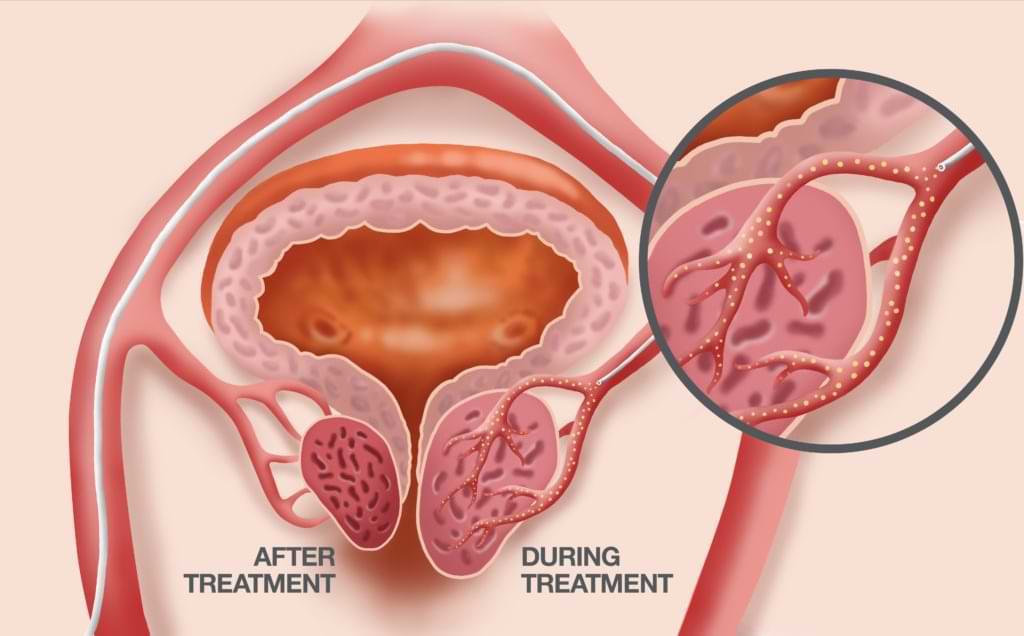
Prostate artery embolization (PAE) is performed by an interventional radiologist, a specialty also called vascular interventional radiology or angiography. Through a small puncture in the groin or wrist, a thin catheter is guided into the prostate arteries, and tiny particles are injected to reduce blood flow. You can read about the procedure itself on our prostate artery embolization page.
Common short-term effects include pelvic discomfort, frequent or burning urination, and sometimes blood in the urine or semen, which usually settle within one to two weeks. In the Swiss randomized trial, pain after the procedure was reported more often after PAE than after TURP (56.3% vs 31.9%). One PAE patient had bladder wall ischemia that needed further treatment (Abt et al., BMJ, 2018).
In the UK register of 216 PAE patients, complications included one case of sepsis, one blood transfusion, four groin hematomas, four local arterial dissections, and two cases of non-target embolization that caused self-limiting penile ulcers (Ray et al., BJU International, 2018). European guidelines also report that acute urinary retention was more frequent after PAE than after TURP (9.4% vs 2.0%) (EAU Guidelines).
How do the results compare?
On average, TURP improves urine flow more than PAE does.
In the Swiss randomized trial, symptom scores (IPSS) fell by 9.23 points after PAE and 10.77 after TURP at 12 weeks, a difference that was not statistically significant. Urine flow, residual urine and prostate size all improved significantly more after TURP (Abt et al., BMJ, 2018). In the UK register, median symptom improvement at 12 months was 10 points after PAE and 15 after TURP, and 20% of PAE patients had a further operation (Ray et al., BJU International, 2018).
The Cochrane review found that symptom and quality-of-life improvement may be similar to TURP, with low-certainty evidence, and that PAE likely increases retreatment (Jung et al., Cochrane, 2022). European guidelines cite a randomized trial with five-year follow-up in which 42% of PAE patients went on to have TURP (EAU Guidelines). Compared with a sham procedure, PAE improved symptom scores by 13.2 points more at six months in men whose medication had not helped (Pisco et al., European Urology, 2020).
| Question | TURP | Prostate artery embolization (PAE) |
|---|---|---|
| Anesthesia | Spinal or general (Abt et al.) | Local anesthesia (Abt et al.) |
| Hospital stay | Usually 1 to 3 nights (BAUS) | Often a day case: 71% in the UK register (Ray et al.) |
| Urinary catheter | Usually removed after 1 day to 1 week (BAUS) | Average 1.3 days vs 3.3 for TURP in the Swiss trial (Abt et al.) |
| Retrograde or reduced ejaculation | 65% to 75% retrograde ejaculation (BAUS) | Fewer ejaculatory disorders than TURP, low certainty (Cochrane) |
| Erections | Poorer erections in 1 in 10 to 1 in 50 (BAUS) | Little or no difference from TURP, low certainty (Cochrane) |
| Urine flow improvement | Larger: +15.34 mL/s (Abt et al.) | Smaller: +5.19 mL/s (Abt et al.) |
| Need for a second procedure | Lower | Likely higher (Cochrane) |
What about sexual function after each procedure?
In the Swiss trial, ejaculatory dysfunction was reported in 56% of assessable men after PAE and 84% after TURP, and erectile function scores did not differ significantly (Abt et al., BMJ, 2018). The Cochrane review agrees that PAE may reduce ejaculatory disorders while erectile function may be similar (Jung et al., Cochrane, 2022). PAE therefore carries a lower rate of sexual side effects than surgery on average, though some men still notice a change.
How long is recovery after TURP and after PAE?
After TURP, most patients need two to three weeks at home before they feel ready for work, and BAUS recommends three to four weeks of rest, especially for physical jobs (BAUS, 2023). The NHS says usual activities return in about 2 to 4 weeks, full healing can take up to 6 weeks, and heavy lifting should be avoided for about 6 weeks (NHS).
After PAE, most patients go home the same day and return to daily activities within a few days. Urinary symptoms gradually improve over weeks to months as the prostate shrinks, so the benefit is not immediate.
Who is a better candidate for surgery, and who for PAE?
Surgery suits men who want the largest improvement in urine flow and are fit for anesthesia. European guidelines describe PAE as an option, with a weak recommendation, for men who prefer a minimally invasive approach and accept less optimal outcomes than TURP. They also note that PAE is still under investigation and should be done in units where urologists and trained interventional radiologists work together (EAU Guidelines).
PAE is usually discussed for men with moderate to severe symptoms who did not improve enough with medication, want to avoid the sexual side effects of surgery, or face higher surgical risk. Careful assessment is needed when prostate cancer has not been ruled out, when arteries are severely diseased or very tortuous, or when kidney function is significantly reduced. For men with an enlarged prostate who have not done well on medication and want to explore a non-surgical route, one option is prostate artery embolization performed by Dr. Adam Farkas, an interventional radiologist, with consultations in Modiin.
For more background, see our pages on enlarged prostate (BPH) and PAE, enlarged prostate treatment without surgery, and what to know before choosing PAE.
Seek prompt medical care if you cannot pass urine, pass blood clots, or develop fever with burning urination. These need evaluation without waiting for a planned consultation.
Sources
- British Association of Urological Surgeons. Transurethral resection of the prostate (TURP) for benign enlargement, patient leaflet, 2023. https://www.baus.org.uk/_userfiles/pages/files/Patients/Leaflets/TURP%20for%20benign.pdf
- NHS. Transurethral resection of the prostate (TURP). https://www.nhs.uk/conditions/transurethral-resection-of-the-prostate-turp/
- Abt D, Hechelhammer L, Müllhaupt G, et al. Comparison of prostatic artery embolisation (PAE) versus transurethral resection of the prostate (TURP) for benign prostatic hyperplasia: randomised, open label, non-inferiority trial. BMJ, 2018. https://pmc.ncbi.nlm.nih.gov/articles/PMC6006990/
- Jung JH, McCutcheon KA, Borofsky M, et al. Prostatic arterial embolization for the treatment of lower urinary tract symptoms in men with benign prostatic hyperplasia. Cochrane Database of Systematic Reviews, 2022. https://cochranelibrary.com/cdsr/doi/10.1002/14651858.CD012867.pub3/pdf/CDSR/CD012867/CD012867_abstract.pdf
- Ray AF, Powell J, Speakman MJ, et al. Efficacy and safety of prostate artery embolization for benign prostatic hyperplasia: an observational study and propensity-matched comparison with transurethral resection of the prostate (the UK-ROPE study). BJU International, 2018. https://pubmed.ncbi.nlm.nih.gov/29645352/
- European Association of Urology. EAU Guidelines on Management of Non-neurogenic Male LUTS, Disease Management chapter (online edition, accessed November 2026). https://uroweb.org/guidelines/management-of-non-neurogenic-male-luts/chapter/disease-management
- Pisco JM, Bilhim T, Costa NV, et al. Randomised Clinical Trial of Prostatic Artery Embolisation Versus a Sham Procedure for Benign Prostatic Hyperplasia. European Urology, 2020. https://pubmed.ncbi.nlm.nih.gov/31831295/
This information is general and does not replace personal medical advice.
Frequently asked questions
Does TURP always cause retrograde ejaculation?
Not always, but it is common. The British Association of Urological Surgeons estimates that 65% to 75% of men have retrograde ejaculation after TURP. Sex should feel the same, but fertility is affected, which men planning children should discuss first.
Does prostate artery embolization cause retrograde ejaculation?
Ejaculation problems are less common after PAE than after TURP, according to a Cochrane review, though the certainty of the evidence is low. In a Swiss randomized trial, ejaculatory dysfunction was reported in 56% of assessable men after PAE compared with 84% after TURP.
Will I need a catheter after TURP or PAE?
After TURP, a bladder catheter is placed at the end of the operation and is usually removed after one day to one week. In the Swiss randomized trial, the catheter stayed in for an average of 1.3 days after PAE and 3.3 days after TURP.
What is the recovery time after prostate artery embolization?
Most PAE patients go home the same day and return to daily activities within a few days. Temporary urinary discomfort usually settles within one to two weeks, and symptom improvement builds over weeks to months.
Who is a better candidate for surgery than for PAE?
Men who want the largest improvement in urine flow, are fit for anesthesia, and accept the sexual side effects often do better with TURP or laser surgery. The decision is made together with a urologist and an interventional radiologist.
Is PAE a treatment for prostate cancer?
No. PAE treats benign prostatic hyperplasia. Any suspicion of prostate cancer has to be evaluated before PAE is considered.
